
Wilson County Parole Versus Probation
Parole is a conditional release from confinement in the Texas Department of Criminal Justice. The Texas Board of Pardons and Paroles makes the release decision. The TDCJ Parole Division then processes an approved release and supervises the person in the community. Probation, which Texas law calls community supervision, is ordered by a court and managed locally by the 81st and 218th Judicial District Community Supervision and Corrections Department. A Wilson County probationer may never have entered TDCJ custody.
The source record matters. A court judgment shows that probation was ordered and states the term. A Board vote code shows what the parole panel decided, but approval can still depend on a program, residence plan, detainer review, or other release condition. Actual parole status should be checked with TDCJ after release processing. These systems can overlap with a separate registry duty, yet a registry entry alone does not establish current parole or probation.
| Point | Parole or mandatory supervision | Wilson County probation |
|---|---|---|
| Legal source | Release from a TDCJ sentence | Community-supervision judgment from a court |
| Decision authority | Texas Board of Pardons and Paroles | The court handling the criminal case |
| Supervising body | TDCJ Parole Division | Wilson County Adult Probation / CSCD |
| Best first record | Board result plus TDCJ release confirmation | Filed judgment and probation-office confirmation |
| End point | Discharge, revocation, or another lawful termination | Completion, early termination, revocation, or court action |
- Parole
- Conditional community release before the full sentence obligation ends.
- Probation
- Court-ordered community supervision that may be imposed without a state-prison term.
- Mandatory supervision
- A Texas release form governed by statute and, for many eligible cases, Board review.
- Discharge
- The end of the sentence or supervision obligation, which is distinct from the earlier release date.
Check Wilson County Post-Release Supervision
Begin with the last actual custodian and the case record. Someone released from the Wilson County Jail may be on bond, local probation, transferred to another custodian, or free of supervision. None of those results can be inferred merely because the person no longer appears in a custody search. A person leaving TDCJ after a favorable parole vote follows a different path. The Board review process and TDCJ release processing provide the relevant state records.
- Identify the case and custodian. Use the Wilson court judgment for probation. For a TDCJ prisoner, match the name with the TDCJ or SID number and conviction county.
- Separate the decision from release. Read the Board vote code or court judgment, then confirm whether the person physically left custody.
- Use the correct office. Contact Wilson Adult Probation for court-ordered community supervision. Ask TDCJ for the assigned parole office after a state-prison release.
- Compare dates and identifiers. Eligibility, vote, scheduled release, actual release, and discharge are separate milestones.
- Check unresolved local process carefully. A court file or limited warrant-detail route can reveal another Wilson matter, but neither is a statewide supervision search.
No official person-by-person Wilson County probation lookup was found. The court judgment is therefore the sound public starting point. TDCJ also does not retain former inmates in its online current-prisoner search, so a vanished result is not a historical discharge entry. The Wilson County released-inmate search path explains how to obtain the jail release or transfer record before deciding which supervision channel applies.
Note: A favorable parole vote, eligibility date, or missing custody result does not by itself establish that Wilson County post-release supervision began.
Wilson County Parole Decision Records
Texas initial parole review is a file-voting process, not a formal hearing with an individual public calendar. An institutional parole officer interviews the prisoner and prepares material for a three-member panel. Two votes determine the result. Approval codes include FI-1, which means release when eligible, other FI variants tied to programs or conditions, and RMS for mandatory supervision. Denial can set a later review, require the person to serve all, or deny mandatory supervision.
A vote is one milestone. TDCJ Review and Release Processing checks the plan, proposed residence, detainers, special conditions, and other criteria before issuing a release certificate. The official Board vote-options page provides the code meanings. Before a vote, the status line is 844-512-0461. After a vote to release, Parole Division release status is available at 512-406-5202. Those two lines answer different stages of the process.
The captured Board interface shows why a code must be read in context. The Texas parole review-results page is the source for the decision language shown here.
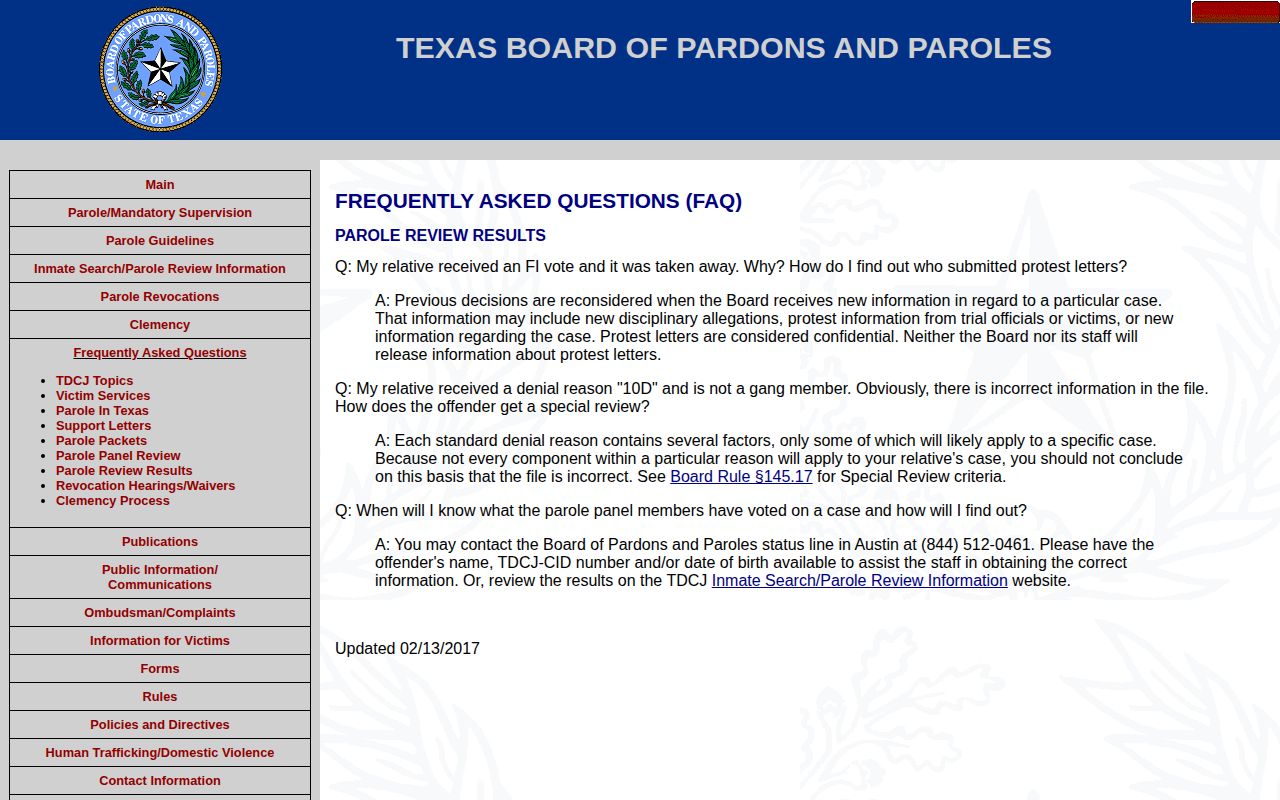
The result code can guide the next call, but only TDCJ release confirmation establishes that the person left the prison unit.
There is no public calendar of formal initial parole hearings because Texas panel members vote the file individually, as the Board panel-review explanation confirms. Board meetings and workshops should not be treated as a named person's parole docket. Revocation hearings are different. They concern someone already released to supervision who is accused of violating conditions and has notice and hearing rights. Keeping those proceedings separate prevents an administrative meeting, an initial file vote, and a post-release revocation case from being reported as the same event.
Wilson County Probation Office Details
The local community-supervision office is Wilson County Adult Probation. It handles court-ordered supervision, not TDCJ parole. Office staff can explain the lawful way to confirm a local probation matter after the correct judgment has been identified. The public page does not provide an open name-by-name probation search.
Wilson County Adult Probation1102 3rd Street
Floresville, TX 78114
Phone: 830-393-7317
Alternate: 830-400-1738
Monday through Thursday, 7 a.m. to 5 p.m., closed noon to 1 p.m.
Friday, 8 a.m. to 5 p.m., closed noon to 1 p.m.
Holiday schedules should be confirmed. For parole, the TDCJ Region 4 directory lists district offices, but it does not expressly assign every Wilson County release to Seguin or any other named office. Supervision follows the approved residence and agency assignment. Ask TDCJ to identify the actual office rather than choosing one by distance.
The matched Wilson Adult Probation image comes from the official county office page.
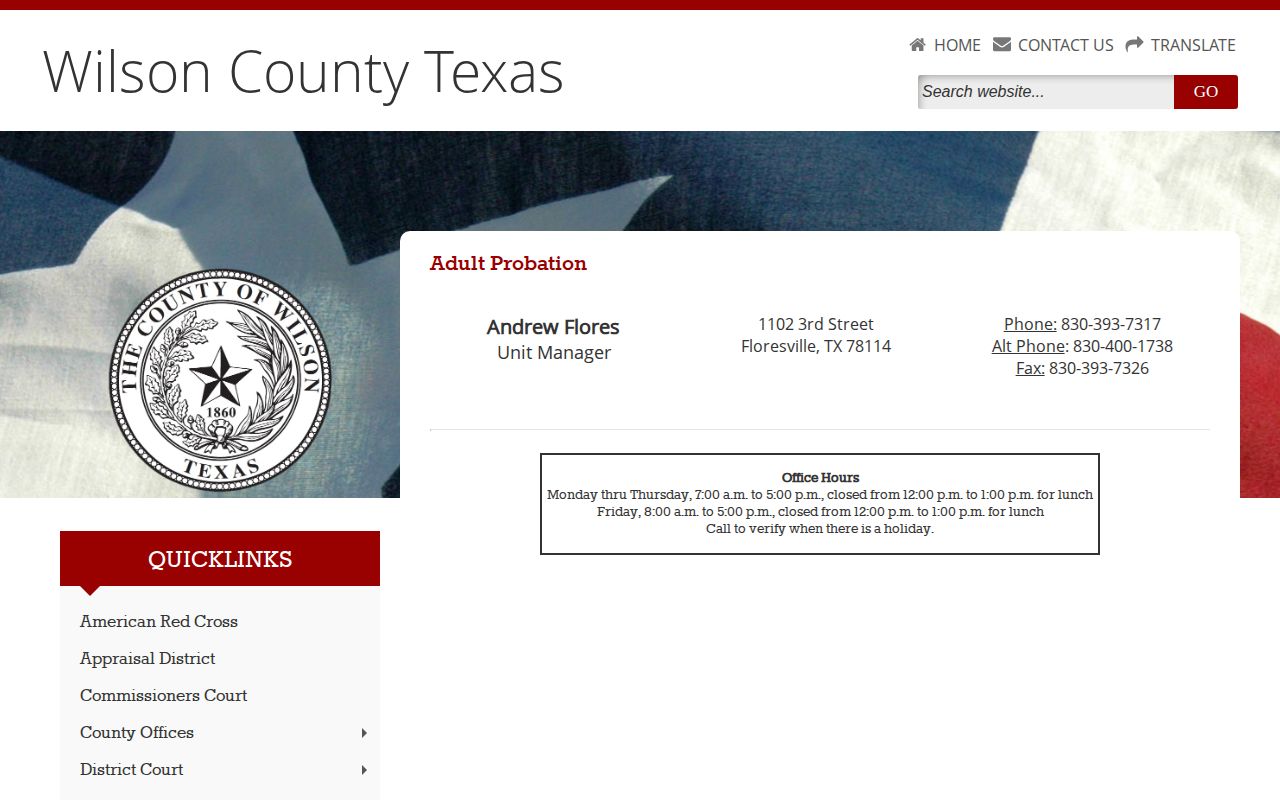
That office is the local contact for probation judgments, while TDCJ remains the route for parole and mandatory-supervision assignments.
Wilson County Supervision Changes
Conditions are enforceable rules attached to parole, mandatory supervision, or probation. They can include reporting, approved residence, treatment, travel limits, or other terms stated by the responsible authority. A claimed violation does not itself show the final outcome. Revocation means supervision may be cancelled after the required process, potentially returning the person to custody. An absconder is someone alleged to have stopped reporting or left supervision without authorization.
Public lists are narrow. TDCJ links a sex-offender absconder search, and the Texas most-wanted program may show selected parole violators. Absence from either source is not proof that no warrant exists. VINE is designed around custody events and notifications; it is not a complete supervision-compliance ledger. For a specific Wilson probation case, use the court and Adult Probation. For parole, use TDCJ and the assigned Parole Division office.
Notification systems also follow the custodian. Participating county custody is checked through Texas VINE. State-prison events use the confidential TDCJ Integrated Victim Services System, which can provide notices about parole eligibility, Board decisions, movement on a bench warrant, upcoming release, and discharge. The TDCJ parole-information channel and telephone-information route answer different record questions. Neither VINE nor IVSS is a general public supervision list. Federal and immigration custody have separate systems, so a Wilson County case does not give VINE universal coverage after a transfer.
Wilson County Warrant Detail Limits
Wilson County Justice of the Peace Precinct 1 directs users to GovRec case details, which may show tickets, charges, and whether and when a warrant issued. This can reveal a separate unresolved local matter after someone was released in another case. It cannot confirm parole absconder status, replace the county jail release record, or serve as a complete Wilson County warrant list.
That distinction matters when records seem to conflict. A person can be released on one cause while another warrant or detainer remains relevant. A detainer is a request or authority that can affect custody or transfer. The issuing court, probation office, Parole Division, or custodian must confirm what the entry means now. Never translate a limited local result into a statewide supervision conclusion.
Note: Wilson JP1 warrant detail can identify a separate local case, but it is not a parole, probation, or county release database.
Wilson County Supervision Discharge
Release and discharge are not synonyms. A person may leave TDCJ on parole while the sentence continues under supervision. Discharge occurs when that sentence or supervision obligation ends. Probation likewise can end through successful completion, a court-approved early termination, revocation, or another lawful order. The correct end record comes from the agency or court that had authority over the supervision.
For state parole, request TDCJ or Parole Division confirmation tied to the person's identifiers and compare the event with the official TDCJ release-type definitions. For Wilson County probation, obtain the filed court order and confirm its meaning with the clerk or Adult Probation. A DPS registry duty, when applicable, is a separate statutory obligation and can continue after custody or supervision ends. A blank roster, a stale web result, or the end of one case should not be used as a substitute for a dated discharge record.